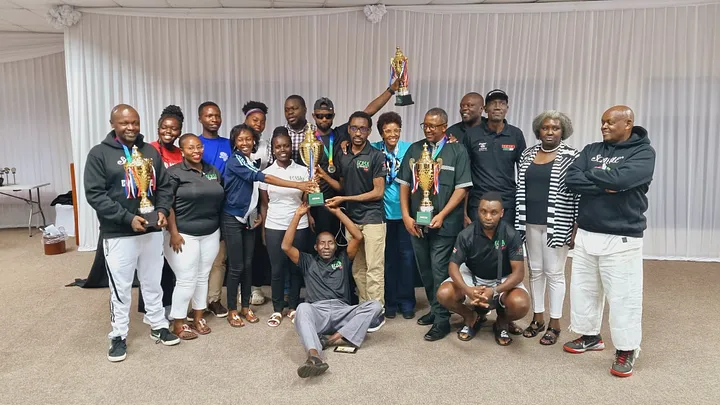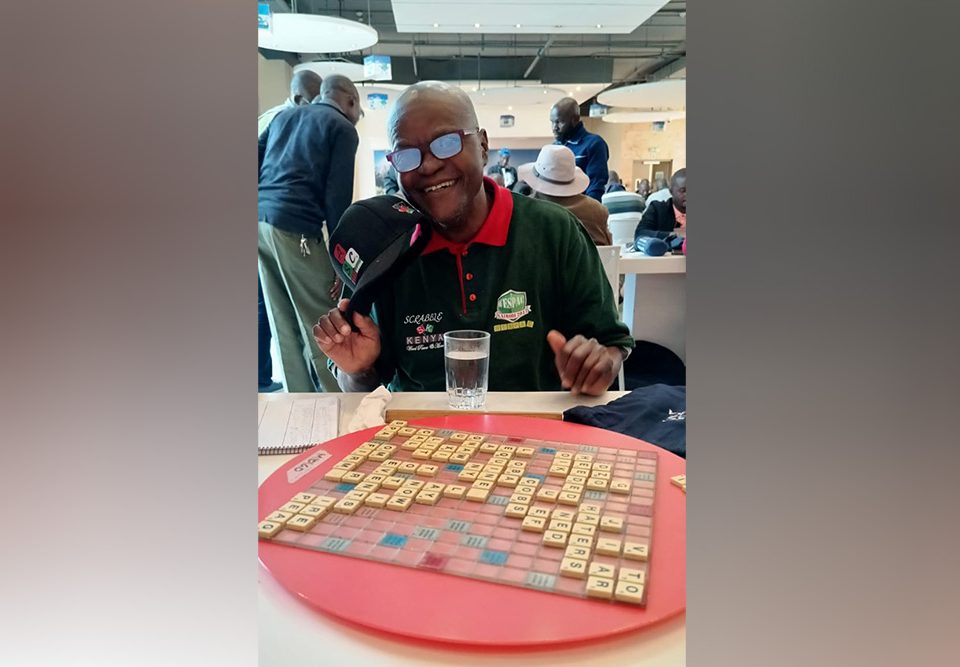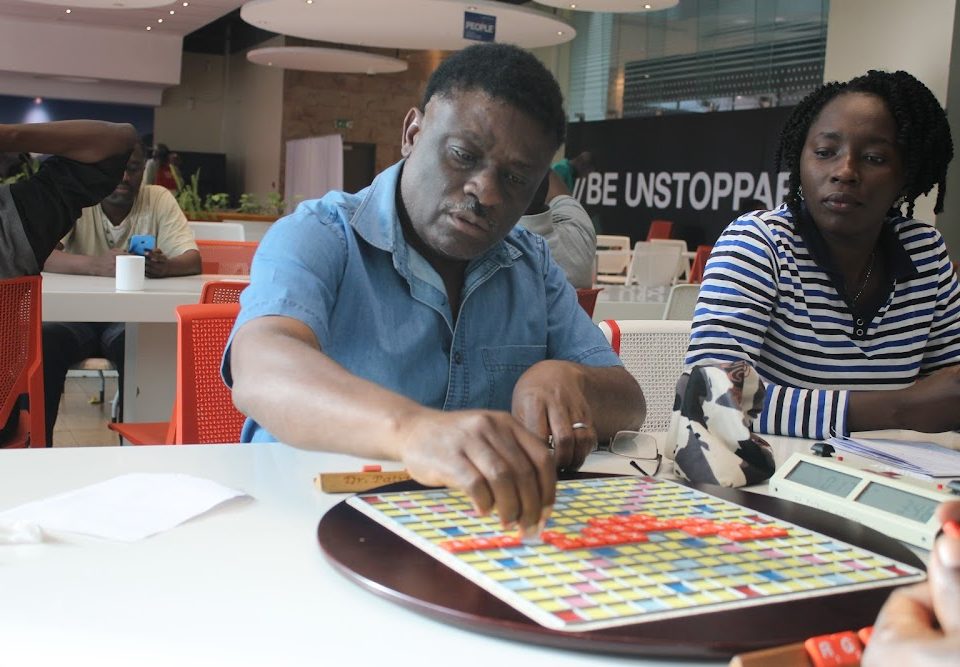
Beyond tiles: Kenya shaping African Scrabble
December 17, 2024
Prologue: Tales of the Scrabble Enforcer
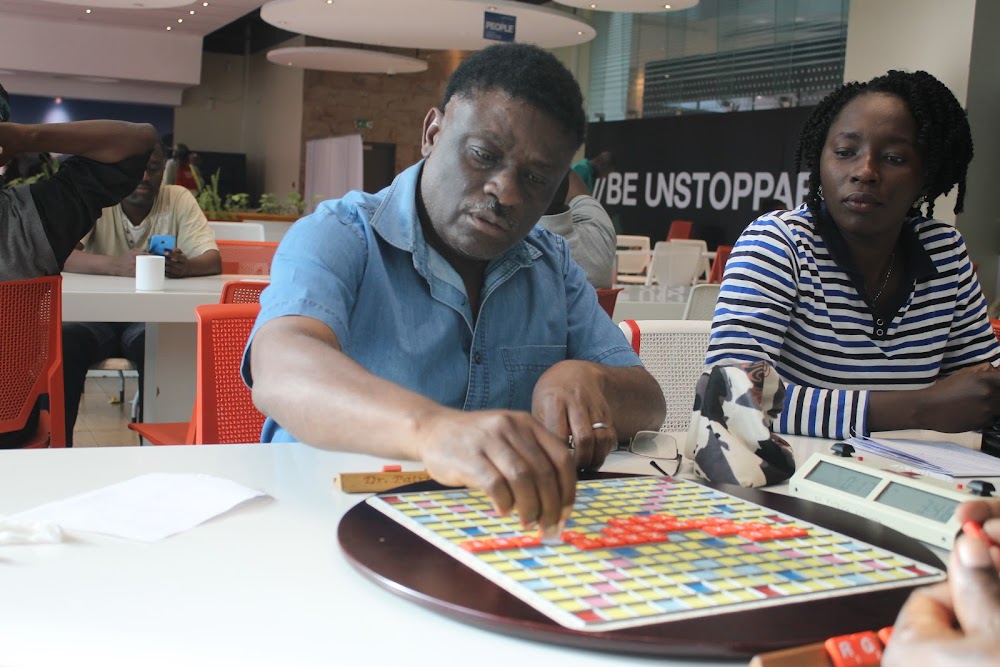
He is a legend. He is Dr. Chris Ntege, a behemoth of the game of scrabble in the East African. As Chief Quality Controller at the National Medical Stores, he is an important fixture in the medical field in Uganda. There is more to the man though. Despite his quiet and unassuming demeanor, he has been the bedrock upon which Ugandan scrabble was rebuilt. In 2024, during the 15th African Scrabble Championship in Kigali, Rwanda, he was deservedly inducted into the Scrabble Hall of Fame. The citation was for his generosity to the game, but for those of us who have travelled with him, we know it was for more than magnanimity and philanthropy. He is a talented player.
When Chris took over the chairmanship of scrabble in Uganda in 2003 at Molly and Paul Primary School in Makindye, South of Kampala, the game gained a gem. He run affairs; he supported it, with cash. With patronage. With passion. He became the spear that opened the way for the future. His vision with a vision that extended far beyond the borders of our country. Specifically, he looked east to Kenya, a nation that was then the undisputed powerhouse of the sport on the continent and in the 90s, the whole wide world. He decided that we would not merely participate—we would compete.
This is the story of that journey, told through the lens of a compatriot who was lucky enough to be on the road with him.
A Cultural Education in Mumias
Dr. Ntege’s first major incursion into the Kenyan scrabble circuit was in 2003, in Mumias, west of Kenya. For many Ugandans, Kenya is simply the neighbor to the east where ugali and nyama choma are the culinary staples. Chris and the Ugandan delegation of Greens Kamugisha, Tawoda Jonathan, Sennoga Ahmed and Tony kyobe quickly learned that the love for roast meat in Kenya borders on the religious, and their preparation methods can be a severe test of one’s digestive fortitude.
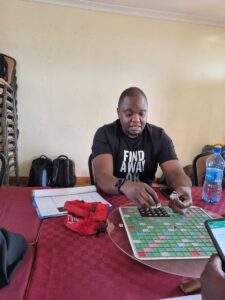 The tournament, organized by the late Fred N. Auka—elder brother to the affable JC Auka—was a revelation to the visitors. It was my first time playing in a tournament of such magnitude. The hall was a constellation of Kenyan stars, including the terrifying Dr. Michael Gongolo, the methodical Dickson Assessa, Kimani Macharia, Bernard Amuke, and the late Denis Omulo (rest in peace). The hosts arranged to give a trophy for a best placed Ugandan in this tournament. That’s how big a challenge the Ugandan players needed to overcome to equalize team Kenya.
But it was the meals that almost broke us. During a lunch break, Dr. Ntege and the Ugandan contingent found themselves staring at a wooden plank loaded with dry goat choma, a mound of stone-hard ugali, sprinkled with kachumbali. There was no soup. We looked around, bewildered, until we realized the locals were drinking their "soup" from teacups. It was a broth, served alongside the meal to wash down the dry meat.
Tony and Chris exchanged a glance of pure cultural shock. They soldiered on, swigging from the teacups between bites, but the aftermath was a brutal introduction to the Kenyan culinary experience—a severe case of constipation that displaced our gut tranquility for days. It was a small price to pay for the lessons we learned on the board that weekend.
The Litunya Era and the "Red Pen" Suffering
During the mid-2000s, the commanding personage in the region was Dr. Litunya. He was a heavy-weight who played at the highest level. The previous year, Dr. Gongolo had placed 13th at the Venetian Hotel in Las Vegas when the United States of America hosted the world championship, but Litunya was rising even higher. We watched him at the World Championship hosted by the Mumbai Scrabble Club at the Taj Presidential Hotel in India in 2007.
While we, the "lesser mortals," retreated to our hotel rooms after games to pore over anagram wordlists, Litunya was flying with the stars.
He carried a modern dictionary housed in a contraption that, today, you might mistake for a mobile phone. He would consult his tool between games for instant gratification, while we spent hours flipping through pages later in the day. We would arrange words alphabetically, flipping page upon page to find the right alphagram. Most times, the words didn't exist. When they did, we would tick the alphagram, preferably with a red pen, marking our progress. It was studious, agonizing work. It was also a testament to the dedication required to compete at that level—a level that Chris Ntege was determined his Ugandan players would reach.
The First ECASA Triumph
In June 2003, during the 1st ECASA tournament hosted by TASPA in Dar es Salaam, a boisterous contingent of Kenyan players descended on the Delice Hotel. I was there alongside compatriots like Tawoda Jonathan, Tony Kyobe, Kayondo Hamdan, Dr. Allan Mpairwe, and Dr. Chris Ntege.
Before the games restarted on the second day, the organizers announced prizes for the best-placed player from each country—Uganda, Zambia, South Africa, and the hosts, Tanzania. Suddenly, the race heated up between us Ugandans. In the final game, I played Bernard Koyyoko and managed to quickly run away from my opponent. That heroic performance placed me 8th on the leaders' board, earning me a worthy glass trophy and a modest US$15. It was, and remains, the sweetest money I have ever earned.
It was also in this period that Dr. Ntege’s strategy began to pay off. He started providing resources to our top players to compete in Kenya. The outstanding yield on that largesse came from the man: Philip Edwin Mugisha (PEM), whom we all knew as "The Phenomenon." Edwin was determined to win in Kenya, and the first opportunity came in Kakamega where he decimated the field and was crowned King of Kenya.
The Birth of The Enforcer
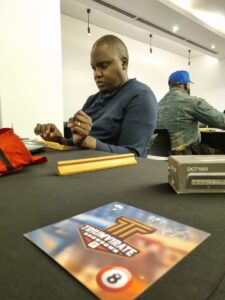 Our scrabble fraternity is one that loves its monikers. Denis Ikekeregor of Nigeria and a double continental champion was known as the "Iron Monkey." Philip Edwin Mugisha borrowed from the Godfather trilogy and adopted the nom de guerre of "The Enforcer" which he duly applied to Dr. Chris Ntege. He became The Phenomenon, while yours became the "Lion from Arua." John Ssempebwa became "The King," Lawrence Onyoin became the amorous "De Lorenzo," Greens Kamugisha as the Behemoth and Onai David became "007" on the Queen’s mission.
It was Edwin, who coined the "Enforcer," moniker, who, after watching Chris’s methodical, defensive style of play, decided to pass the mantle. He saw in Chris a style reminiscent of Catenaccio—the famous defensive tactic popularized by Arrigo Sacchi and the Italian national football team of the 90s. Chris didn’t just attack; he suffocated. He bled the clock and played with a poker face that unsettled the most seasoned champions. Thus, Edwin christened Chris "The Enforcer." It was a title that would soon strike fear into the hearts of the Kenyan elite.
The Sultan of Mombasa
Perhaps the most audacious move in Chris’s career was a stealth mission to Mombasa. Dr. Ntege "sneaked" The Phenomenon and Lawrence Onyoin into the country, slipping anonymously into the coastal city for a tournament. When Dr. Muema Mumbi, the Secretary General of Scrabble Kenya, realized what had happened, he was stunned and anguished. He frantically called for reinforcements from Nairobi, urging the top seeds to rush to the rescue of their nation.
But it was too late. It was a case of spilled milk. Chris, PEM, and Lawrence dominated that tournament so thoroughly that through PEM in the common Ugandan parlance drunk the completion like soup. For his singular exploits, he was crowned the “Sultan of Mombasa."
In 2018, PEM put the entire world on notice and caused headache for the Kenyan scrabble community. At the Triple Trojan Hotel in Kisumu, he took out the elite Kenyan players in a moment of supreme pride for Uganda. It was a game that atoned for the misses of Bondo, where Francis Wachira had previously risen to save the face of his country from the ignominy of losing to us. Three times. A great feat.
The Aga Khan Campaign and the PENALISER Gambit
July 4th 2026, as America celebrated its 250th anniversary, another Mombasa tournament beckoned. This time, Chris went to the Agha Khan Academy, not with just the stars, but with young players in tow—Muhanguzi Daniel and Ochieng Abraham. They entered the tournament largely as unknowns, but Chris set off in earnest from the very first round to show intent. Panic beset the room as Chris romped through the competition, dispatching top players.
For his efforts, Chris perched atop the leaders' board for the entirety of day one this breezy Saturday. By game 8, he had displaced the formidable Magwanga Onani in ruthless fashion. Onani had kept it competitive, finding SOROBAN, SEALINE, and COTWALS. But Chris produced a stunning display of board vision, laying down TRAINEE alongst SEALINE through all seven letters, matching them letter for letter for a hefty 96 points. He topped it with DASHIER to cross to 509 points against Onani's 426. It was a breathtaking repertoire from which Onani could not recover.
The country took notice. Dr. Muema Mumbi was unsettled. Even Okeyo, normally ambivalent urged Chris to leave his door open to receive gifts after the games. Kenya was rattled because they realized they were facing a new breed—a disciple of The Phenomenon and Dr. Edgar Odongkara, a player determined to conquer Mount Kenya. That evening, his host JC AUKA took him to explore the ocean-scape in Mombasa and to reward him generously for his mind bending games of the day. JC AUKA had spared no expense to plan, host and sponsor the Mombasa tournament.
The following morning, In game 12, Chris faced perhaps the most fiercely jingoistic of all Kenyans: Francis Wachira, a legend who has won multiple national tournaments. Chris arrived at the table late—16 minutes late, to be precise—to find that Wachira had already started his clock. To compound matters, Wachira raced ahead, finding FRONTED, VAXES, and ECHOIZES to go 200 points ahead in just four moves.
Trust Chris to change tactics. He began his pursuit with REVOLTS, IGUANID, and PUNCTURE. But the final blow was yet to come.
In a moment that broke the heart of a nation, Chris laid down PENALISER. His opponent agonized over the board, rationalizing the letters. Eventually, he explained to Chris the meaning of the word. Fred Magu was aghast, because PENALISER is a phoney. 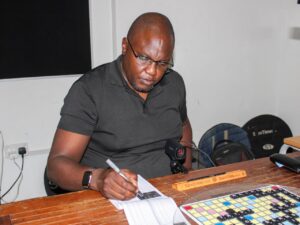
But Chris had mastered the psychology of the game. With a deadpan, poker face, he had stared down the legendary Wachira. He didn't flinch. He didn't break. He simply relied on the aura of "The Enforcer." His opponent, rattled by the confidence, yielded and accepted the loss. It wasn't just a win on the board; it was a win in the mind.
The Final Duel
This opponent is the sweetest. Because a win here assuages the mind. It answers for defeats of many years. In game 14, it was the turn of Dr. Patrick Litunya—the man who had been my hero since 2003. In the endgame sequence, Chris held a vowel-less rack of DDSLY, while Litunya was dancing with a beauty like H?GLIKE. The game hung in the balance. But the Enforcer managed to force the tiles in masterful end game sequence, and the great Litunya could not overcome Chris's defensive wall. The legend lost the game.
By the 18th game, even the great Dr. Gongolo had to dig deep into his vast archive of words to stop Chris from becoming yet another Sultan of Mombasa.
As I watched Chris’s journey, from the stone-hard ugali of Mumias to the Agha Khan Complex in Mombasa, I realized that the story of Dr. Chris Ntege is not just a story of scrabble. It is a story of mentorship, of patience, and of a quiet, unyielding will. He changed the trajectory of the sport in Uganda. He financed a generation, and by doing so, he ensured that the East African scrabble circuit would never be the same again.
By Richard Geria